Down the Hill
It gives me great honour to write an impact piece for Baby Brian. His life, his death, his sweet incorrupt body have given me, a grieving mother, consolation at a time when I deeply needed it.
Last year, my youngest daughter, Rose, was born still. It was a sorrow I didn’t know I was capable of carrying, and yet, when I held her precious body in my arms I knew I was made to carry her… that any and all sorrow would be worth it just to look upon her face.
I leaned so heavily on my Catholic faith and the hope of the resurrection to guide me through my grief. In my darkest moments I would tell myself, “Rose lives.” I truly believed that Rose was with God. He made her so perfectly. This was not someone He created to then “leave in limbo” as the old theory goes. No. She held a purity, and a peace, and a unique personhood that could not be forgotten: “Can a mother forget her infant, be without tenderness for the child of her womb? Even should she forget, I will never forget you.” (Isaiah 49:15, NABRE)
And yet, in spite of my belief that she truly was with God, the ache of losing Rose was only amplified by this nagging sorrow that only recently the Church has softened her stance on the salvation of unbaptized infants. Now leaning more towards a posture of “hope” in God’s mercy, but still, not the same assurance that is offered to catechumens who pass away prior to receiving baptism:
“For catechumens who die before their Baptism, their explicit desire to receive it, together with repentance for their sins and charity, assures them the salvation that they were not able to receive through the sacrament.” (CCC 1259)
“As regards children who have died without Baptism, the Church can only entrust them to the mercy of God … allow us to hope that there is a way of salvation for children who have died without Baptism.” (CCC 1261)
These may seem like similar phrases but, for a parent who has lost a baby, I can assure you that the difference in the wording of “assures them the salvation that they were not able to receive” and “allow us to hope that there is a way of salvation” is vast. One comforts the heart; the other leaves it searching…
My child, “This one, at last, is bone of my bones and flesh of my flesh” (Genesis 2:23, NABRE). My littlest one…Where are you?
This spiritual ache recently materialized when my husband and I found ourselves wandering through a cemetery close to my son’s baseball game, as we had an hour before it would begin. While we are very familiar with the cemetery my daughter is buried in, this one was unknown to us. It was older and larger than we realized, so my husband pulled up an online map of the grounds, and my eyes were immediately drawn to the section marked for unbaptized infants.
We quietly wandered through the cemetery, wondering when we would find this section, trying to read the tombstones that had weathered over time.
“Is it here?… No. Here? No… Where is it?”
Finally, we realized that, in an area of the cemetery that was quite literally down a hill, there were a few scattered headstones for babies who had passed away on the day they were born. The sight of this obscure spot stirred within me a familiar ache. This was just one of many places where unbaptized babies were laid to rest apart from everyone else. I couldn’t help but think, “How could the Church embrace the unborn child so completely in life and yet in death leave that same child to be buried in the margins?”
The Catholic Church is not just my religion; it is my home. So how is it that this incredible sanctuary will house me, but my baby (more innocent and pure than I could ever hope to be) is, figuratively, and in many parents’ cases throughout history, literally buried outside her walls? Beyond her gates? Down the hill?
These are real questions I have struggled with, and God is not afraid of them. Nor is the Church. The Church has preserved humanity’s wrestling match with the Lord, from Jacob’s limp, to Job’s cry, to the suffering poetry of Lamentations.
The Church has never shied away from human suffering and the questions that accompany it, but because she is entrusted with the preservation of truth, she moves cautiously through deep theological tradition, discernment, and careful reflection. Documents like, The Hope of Salvation for Infants Who Die Without Being Baptized, published by the International Theological Commission in 2007, are written with great consideration and take time to be properly reviewed and approved. And all the while, God, in His delightful mystery, simultaneously raises up pilgrims from each generation to encourage us, fortify us, and give us a face that embodies the Church’s hope.
And this, I believe, is where Baby Brian comes in. Baby Brian, in his sacred stillness, brings documents like, The Hope of Salvation for Infants Who Die Without Being Baptized, to life. He, through his incorrupt little body, his wispy hair, and his peaceful facial features proclaim a hope for the faithful that resonates deep into the hearts of grieving parents. Without grandeur, without noise, and even without breath he manages to bear witness to God’s mysterious and everlasting love.
Though I am aware that investigations are underway to further understand Brian’s incorrupt nature and that protocol must be followed, I cannot help but look upon the photo of Mary Pat Gallagher holding her baby boy thirty seven years after his burial and praise God for the miracle that took place that day.
We worship a good, faithful, and steadfast God. He is at work in everything and everyone, and my heart is moved to tears that He would take a story marked by decades of loss, reinterment, and even a broken casket, and turn it into balm for the hearts of so many parents who have wept over the uncertainty surrounding their precious child’s salvation. And I, in my heart, believe that is what God is doing through Baby Brian: raising up one of His littlest ones to proclaim hope for the countless parents who were asked to bury their baby down the hill.
Before I formed you in the womb I knew you,
before you were born I dedicated you,
a prophet to the nations I appointed you.
“Ah, Lord God!” I said, “I do not know how to speak. I am too young!
But the Lord answered me,
Do not say, “I am too young.”
To whomever I send you, you shall go;
whatever I command you, you shall speak.
Do not be afraid of them,
for I am with you to deliver you.
(Jer 1:5-8, NABRE)
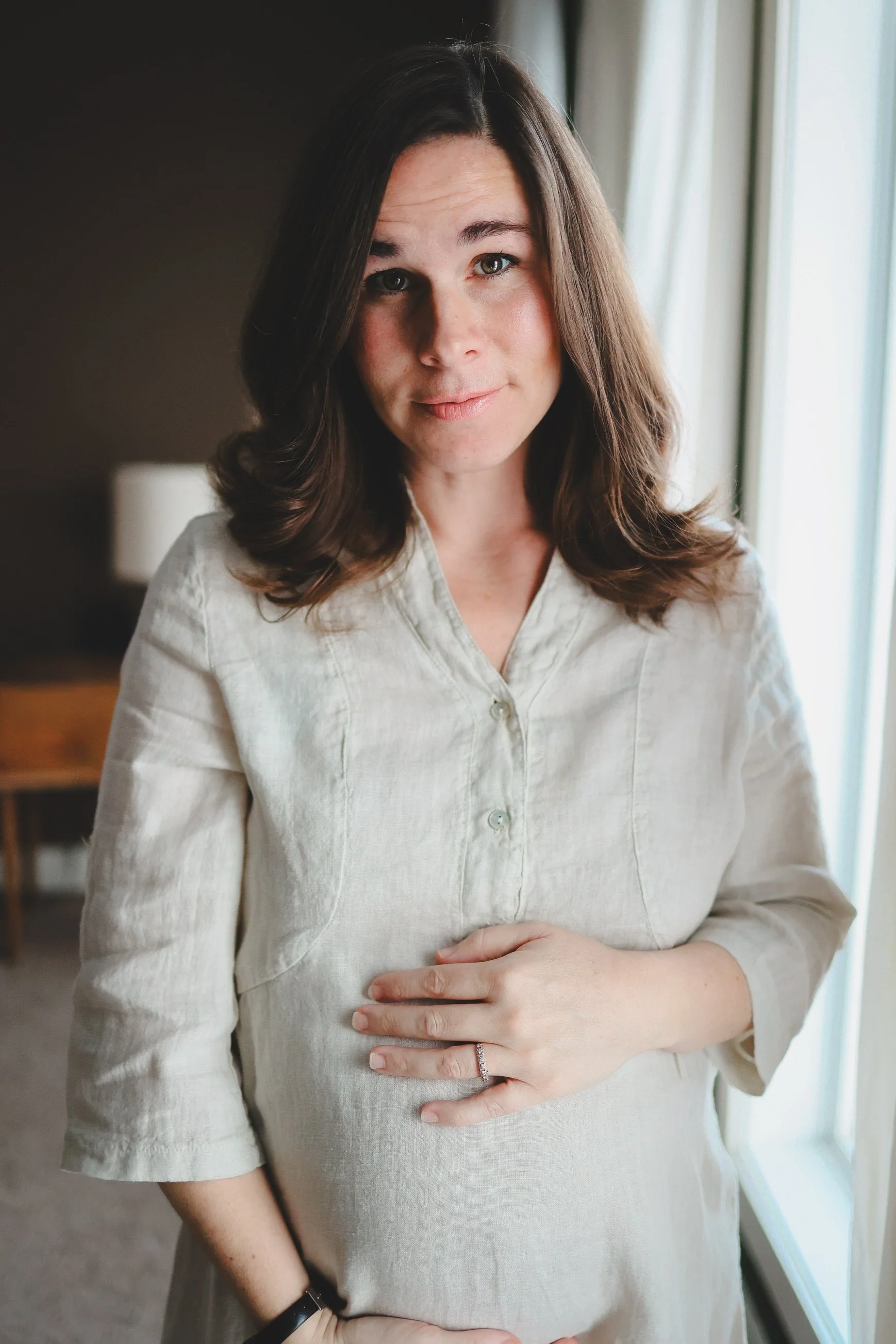
Laura Hussey
Laura Hussey lives in Alberta, Canada with her husband and three children. Laura holds a Bachelor of Fine Arts and is a newborn and family photographer drawn to storytelling through both images and words. A lifelong writer, she turns to words as a place of prayer and reflection as she navigates grief, motherhood, and faith.
(Photograph taken during her pregnancy with Rose, her beloved stillborn daughter)